How to Use Tokenized Stocks as Collateral for Perps on Aster (2026)
Fees and rules are checked against Aster's documentation at docs.asterdex.com, and live market figures come from Aster's public API. How we verify
Table of Contents
For years the line between holding stocks and trading crypto perps was hard: your brokerage equity could not back a position on a decentralized exchange. Tokenized equities have blurred part of that line. As of June 15, 2026, Aster's collateral table accepts tokenized stock tokens issued by Binance as collateral for perpetual futures, so you can open a crypto position while that equity-tracking exposure keeps working in the background.
The mechanics have sharp edges worth understanding before you use them. This guide covers which assets Aster lists, how the collateral haircut and cross-margin work, a worked example, the risks of margining with a volatile equity-tracking token, and how Aster's privacy model fits in. Verify the specifics on docs.asterdex.com before trading, because Aster ships fast.
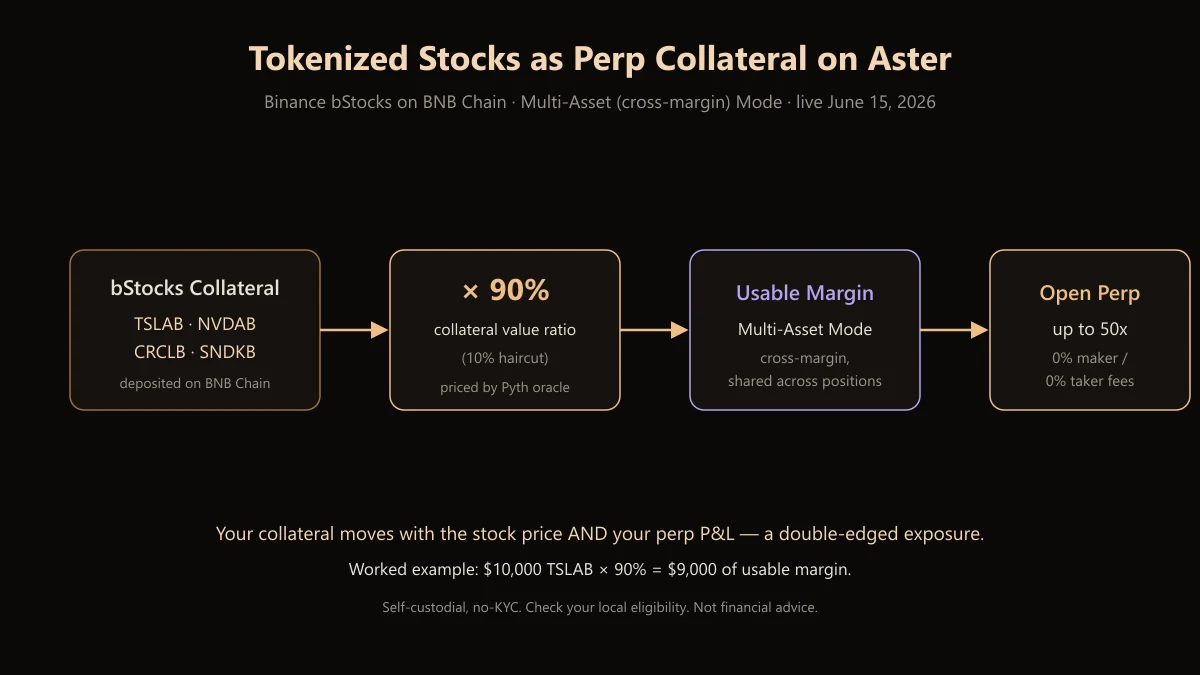
Aster accepts four Binance-issued bStocks tokens (TSLAB, NVDAB, CRCLB, SNDKB) on BNB Chain as perp collateral via Multi-Asset Mode (cross-margin). Each counts at a 90% collateral value ratio (a 10% haircut). Aster's fee docs list stock perps at 0% maker / 0.009% taker with up to 50x leverage, priced from third-party Pyth oracle feeds. The catch: your collateral value moves with the stock price, so a losing equity and a losing perp drain margin together.
What "Tokenized Stocks as Collateral" Actually Means
A tokenized stock is an on-chain token that tracks the price of a listed equity. What stands behind any particular token, how redemption works, and what rights a holder does or does not have are set by whoever issues it, so read the issuer's own documentation rather than assuming a uniform standard.
The tokens on Aster's list use the bStocks format, which is Binance's tokenized-equity product. Binance is the issuer; Aster's role is accepting the token as margin. That distinction matters if something goes wrong with the instrument itself, because the party responsible for the instrument is not the venue you traded on. Tokens from other issuers, including xStocks, Backed and Ondo, are not on Aster's collateral list as far as we could verify in August 2026.
"As collateral" means these tokens can back your margin instead of you having to convert to a stablecoin first. You deposit the stock token, and its haircut value counts toward the margin that supports your open perps. You keep the equity-tracking exposure and get trading buying power from the same asset.
There is one structural requirement: this only works in Multi-Asset Mode, Aster's cross-margin mode. In Single-Asset Mode (isolated, USDT-only) the stock tokens are not usable as collateral at all. We will come back to why that matters for risk.
The Four Supported Assets
Aster's collateral table lists four bStocks tokens, all on BNB Chain:
| Token | Tracks | Collateral value ratio |
|---|---|---|
| TSLAB | Tesla | 90% |
| NVDAB | Nvidia | 90% |
| CRCLB |  Circle Circle | 90% |
| SNDKB | SanDisk | 90% |
Two limits to keep in mind. First, this is BNB Chain only. Aster's other deployments (Ethereum, Arbitrum, Solana) do not list these tokens in their collateral tables, so if you want to use stock collateral you need to be on  BNB Chain. Second, the list is short and curated rather than a broad slice of the equity market.
How the 90% Collateral Haircut Works
Every asset Aster accepts as collateral gets a collateral value ratio, the fraction of its market value that counts toward your usable margin. The four stock tokens are set at 90%, meaning a 10% haircut.
To put that in context, here is roughly where stock tokens sit on Aster's BNB Chain collateral ladder:
| Asset class | Example | Collateral value ratio |
|---|---|---|
| Stablecoins | USDT, USDF | ~99.99% |
| Top crypto | BTC, ETH, BNB | ~95% |
| Tokenized stocks | TSLAB, NVDAB, CRCLB, SNDKB | 90% |
| ASTER token | ASTER | ~80% |
Whatever the reasoning behind the ratio, the effect for you is a buffer: 10% of the token's market value does not count, which gives the risk engine room before a falling collateral value threatens open positions. The takeaway: the dollar value showing in your wallet is not the margin you get. Multiply by 0.90 to know your real buying power from stock collateral.
A worked example
Suppose you hold $10,000 of TSLAB and want to trade crypto perps without selling that exposure.
Deposit the stock token
You move $10,000 of TSLAB into your Aster futures account on BNB Chain.
Apply the haircut
At a 90% collateral value ratio, that TSLAB provides about $9,000 of usable margin, not the full $10,000.
Open a perp
You use that $9,000 of margin to open a BTC perp. The position size depends on the leverage you choose; the margin is shared across all your positions in cross-margin.
Watch both exposures
Your margin now moves with two things at once: the stock price behind your collateral and BTC's price in your position. Both feed the same health calculation.
This example is illustrative. We could not find a published maintenance-margin schedule for stock collateral in Aster's documentation, so do not infer a specific liquidation price from it. Use it to understand the shape of the mechanics, not to size a real trade.
Warning
Because stock collateral only works in cross-margin (Multi-Asset Mode), all your positions and your stock collateral share one margin pool. That is efficient, and it also means a problem in one position, or a drop in your stock collateral, can pull down the health of everything at once. Cross-margin amplifies both convenience and risk.
The Risk That Is Easy to Miss: Correlated Drawdowns
The headline risk with equity-token collateral is not the haircut, it is correlation. With a stablecoin, your collateral value is roughly constant, so only your position moves. With TSLAB or NVDAB, your collateral and your position can move against you at the same time.
Picture the bad case: you are long a crypto perp and the market sells off. At the same moment, tech equities sell off too, so your equity-backed collateral also drops. Your position is losing money while the margin meant to support it is shrinking. The two effects compound, and liquidation arrives faster than the same trade backed by USDT would.
A second factor is market hours. Tokenized stocks can trade around the clock on-chain, but the underlying equities do not. When US markets are closed, liquidity in the stock tokens is thinner, and prices can gap between sessions. Collateral is valued from feeds published by Pyth, a third-party oracle network, rather than from a price Aster sets, and thin liquidity during off-hours still means sharper moves and a higher chance of sudden liquidation for an over-leveraged account.
Warning
Tokenized stock collateral is best treated as a way to keep equity-tracking exposure while trading, not as a way to max out leverage. The conservative approach is to use well under the 90% headroom, keep leverage modest, and remember that an equity-backed position has two moving parts instead of one. Never margin with money you cannot afford to lose. This is not financial advice.
Trade Perps With a 5% Fee Rebate
Sign up with referral code MMTz04 and, under Aster's documented referral program terms, 5% of your trading fees comes back to you as a rebate across crypto perps and spot.
Start Trading on AsterFees and Leverage on Stock Perps
Aster's fee documentation lists tokenized stock perpetuals at 0% maker and 0.009% taker, with leverage up to 50x. That rate is for the stock perp trade itself, and it is a different thing from the 10% collateral haircut on stock tokens used as margin. Do not confuse the two: one is the cost of trading a stock perp, the other is how much your stock collateral is worth as margin.
The perp side is also broader than the collateral list. Collateral is limited to the four bStocks tokens above, while the tradable stock perps run wider, including the TSLA perpetual market and NVDA on Aster, both running around the clock at up to 50x. Each of those contracts is priced from a third-party oracle feed rather than from an exchange-set price, so it is worth checking which feed backs a given contract before you trade it.
For context on the rest of the fee table:
- USDT-margined crypto perps: 0% maker, 0.04% taker.
- USD1-margined perps: 0% maker, 0.005% taker. Aster is also running a rewards campaign on six of these pairs, with the rules set out in the USD1 RWA Boost.
- Pay in ASTER: a documented 5% fee discount, separate from the referral rebate.
For the full breakdown across every market, see Aster fees explained and the fees hub. Fee schedules change often, so confirm current rates in the docs before trading.
Getting Started, Step by Step
If you have read the risk section and want to try it, here is the flow at a high level. Start at app.asterdex.com and, if you are new, walk through how to trade on Aster first.
Connect a wallet on BNB Chain
Connect a self-custodial wallet such as  MetaMask and switch the network to BNB Chain, since tokenized stock collateral is BNB Chain only.
Acquire the bStocks token
Obtain the tokenized stock token you want to use (for example TSLAB or NVDAB) and hold it in your wallet. These are issued by Binance under its bStocks format, so its terms govern the instrument.
Deposit into your futures account
Move the stock token into your Aster futures account on BNB Chain so it shows up in your balances.
Enable Multi-Asset Mode
Switch on Multi-Asset (cross-margin) Mode. This is what makes non-USDT assets, including the stock tokens, count as collateral. In Single-Asset Mode they will not.
Open your position
With the haircut margin available, open your perp. Keep leverage modest and monitor both your collateral's underlying stock price and your position.
How Aster's Privacy Model Fits In
One reason traders choose Aster over a centralized venue for this is its privacy design. Aster supports hidden orders and hidden positions: limit orders that are not published in the public order book with visible size, and resulting positions kept out of public position data. Order details stay concealed until execution, which reduces how easily bots can front-run or position-hunt your trade.
For equity-collateralized perps that matters more than usual, because a large, identifiable position backed by a known stock token would otherwise be an obvious target. The full mechanics are covered in Aster hidden orders explained. Combined with self-custody, it is what an independent equity-collateral trader is usually after.
Info
Aster is self-custodial and, as of August 2026, does not ask you to verify your identity before trading, but you remain responsible for your own local eligibility and tax obligations. Whether tokenized-stock products are available or appropriate where you live, and how any gain or loss is taxed, is a question only your jurisdiction can answer. This is not financial, legal or tax advice.
The Bottom Line
Tokenized-stock collateral expands what a DEX can do: keep an equity-tracking token on-chain and use it as margin to trade perps, self-custodially and with hidden-order privacy. The mechanics are specific, though, and worth respecting. Four Binance-issued bStocks tokens on BNB Chain, a 90% collateral ratio, cross-margin only, stock perps at 0% maker and 0.009% taker up to 50x, and a correlation risk that means your collateral and your position can fall together. Used conservatively it is a useful tool; used as an excuse to over-leverage a volatile equity-tracking token, it is a fast way to a liquidation. Verify the live details in the Aster docs and the issuer's own terms, size for the bad case, and start small.
Ready to Trade on Aster?
Create an account with code MMTz04 to lock in a 5% fee rebate under Aster's program terms, then explore Multi-Asset Mode with collateral you can manage.
Get Started on AsterFrequently Asked Questions
Yes. As of June 15, 2026, Aster's collateral table accepts bStocks tokenized equities, which are issued by Binance rather than by Aster, as collateral for perpetual futures. You deposit the stock tokens into your futures account on BNB Chain and switch on Multi-Asset Mode, a cross-margin mode that lets non-USDT assets back your positions. The listed tokens are TSLAB, NVDAB, CRCLB and SNDKB, all on BNB Chain. Aster's role here is accepting the token as margin; the instrument itself is the issuer's product.
Each of the four tokenized stocks counts toward your usable margin at a 90% collateral value ratio, which is a 10% haircut. So $10,000 of TSLAB provides about $9,000 of usable margin. That sits below stablecoins like USDT at 99.99% and major crypto like BTC and ETH at 95% on Aster's BNB Chain collateral ladder. Ratios are set by Aster and can be revised, so check the live table.
Four bStocks tokens, all on BNB Chain: TSLAB, NVDAB, CRCLB and SNDKB. bStocks is Binance's tokenized-equity format. Tokens from other issuers, such as xStocks, Backed or Ondo, are not on Aster's collateral list as far as we could verify. Tokenized-stock collateral is only available on BNB Chain, not on Aster's Ethereum, Arbitrum or Solana deployments, and only inside Multi-Asset (cross-margin) Mode.
Yes, and in a specific way. Your collateral value moves with the stock price at the same time your perp position moves with its own market. If the equity falls while your BTC long also loses, your margin erodes from both sides at once, which can accelerate liquidation. Tokenized stocks can also trade against thin liquidity when US markets are closed, so prices can gap. Size positions conservatively and treat the 90% headroom as a ceiling, not a target.
Aster's fee documentation lists stock perpetuals at 0% maker and 0.009% taker, with leverage up to 50x. That rate applies to the stock perp trade itself and is separate from the 10% collateral haircut on stock tokens used as margin. For crypto perps, USDT-margined pairs are 0% maker and 0.04% taker, and paying fees in ASTER adds a 5% discount. Fee schedules change, so confirm current rates in the docs.
Sources & Citation
How these figures were verified
- Aster official documentation (Single & Multi-Asset Mode) — the collateral value ratios, the 90% ratio on the four bStocks tokens, and the Multi-Asset cross-margin requirement. Checked .
- Aster official documentation (Perpetuals: Fees) — the 0% maker / 0.009% taker stock perp rate, USDT- and USD1-margined crypto perp rates, and the 5% pay-in-ASTER discount. Checked .
- Aster official documentation (Hidden Order and Hidden Position) — how hidden orders and hidden positions behave on Aster's perp book. Checked .
- Aster official documentation (Referral Program) — the referral program terms and the fee rebate paid to referred users. Checked .
- Binance (bStocks) — the issuer of the TSLAB, NVDAB, CRCLB and SNDKB tokens. What stands behind each token, and what rights a holder does or does not have, is defined by the issuer's own terms, not by Aster or by this site. Checked .
- Cryptonews.net — launch coverage of the June 2026 tokenized-stock collateral rollout, cited under fair use. Checked .
- The Cryptonomist — earlier coverage of Aster's stock perpetual launch and its fee framing, cited under fair use. Where this coverage and Aster's own fee page disagree, we use the fee page. Checked .
Aster revises its fee schedules, leverage caps and token mechanics regularly, so every figure here is a dated snapshot rather than a live feed. Where a number comes from Asterpedia’s own tracking rather than the documentation, it is labelled as such above.
Cite this page
Asterpedia. "How to Use Tokenized Stocks as Collateral for Perps on Aster (2026)." Published June 24, 2026; last updated August 14, 2026. https://asterpedia.com/guides/trading/tokenized-stocks-collateral-perps<a href="https://asterpedia.com/guides/trading/tokenized-stocks-collateral-perps">How to Use Tokenized Stocks as Collateral for Perps on Aster (2026)</a> — Asterpedia, updated August 14, 2026Reuse
You may republish these figures with attribution and a link to https://asterpedia.com/guides/trading/tokenized-stocks-collateral-perps.
Asterpedia is an independent, unofficial resource. It is not affiliated with, produced by, reviewed by, endorsed by or sponsored by Aster, asterdex.com, their operators, or their backers including YZi Labs. "Aster", "ASTER" and the Aster logo are trademarks of their respective owners, used here for identification only.
Disclaimer: Nothing here is financial, investment, legal or tax advice. Trading perpetual futures carries a substantial risk of loss. Whether any product described here is lawful or appropriate where you live, and how any trade is taxed, depends on your jurisdiction and your circumstances. Check the primary sources and speak to a qualified professional. This site contains referral links, and the full disclosure is in the site footer.
Ready to Start Trading?
Sign up to Aster with referral code MMTz04 and 5% of your trading fees come back to you as a rebate. Connect a wallet and you are trading in minutes.
Trade on Aster - 5% Fee Rebate