Aster Fees Explained: Perps, Spot, 1001x & ASTER Discounts (2026)
Fees and rules are checked against Aster's documentation at docs.asterdex.com, and live market figures come from Aster's public API. How we verify
Table of Contents
- The Aster fee schedule at a glance
- What does Aster charge for maker and taker orders?
- What does spot trading cost on Aster?
- How is the 1001x fee model priced?
- Two ways to pay less
- 1. Pay your fees in ASTER (5% discount)
- 2. Referral code MMTz04 (5% fee rebate)
- Can you use both discounts at the same time?
- How do you pay less in fees on Aster?
- How Aster's fees compare conceptually
- Bottom line
Trading fees decide how much of your edge actually reaches your wallet. On a perpetuals exchange where you might cycle in and out of positions dozens of times a day, a few basis points compound into real money. This guide breaks down the main fees on Aster DEX in 2026: perp maker and taker rates, spot rates, the unusual 1001x fee model, and the two ways to reduce what you pay. Figures come from Aster's published fee documentation, and because Aster revises its schedule often, we flag where to confirm the live numbers yourself.
Aster's fee docs list 0% maker / 0.04% taker on USDT-margined perps and 0.005% maker / 0.04% taker on spot at the base tier. Two things reduce your cost, and they work differently: paying fees in ASTER takes 5% off at the point of trade, and signing up with referral code MMTz04 gets you 5% of the fees you pay credited back as a rebate. The first needs you to hold the token, so see how to buy ASTER if you do not yet. Fees move fast, so verify current rates in the app or docs.
The Aster fee schedule at a glance
 aster
aster
Aster is a multi-chain decentralized perpetuals exchange with order-book perps, spot, and a one-click high-leverage mode. Each of those surfaces has its own fee structure. Here is the base-tier schedule, cross-checked against Aster's official documentation at docs.asterdex.com in 2026:
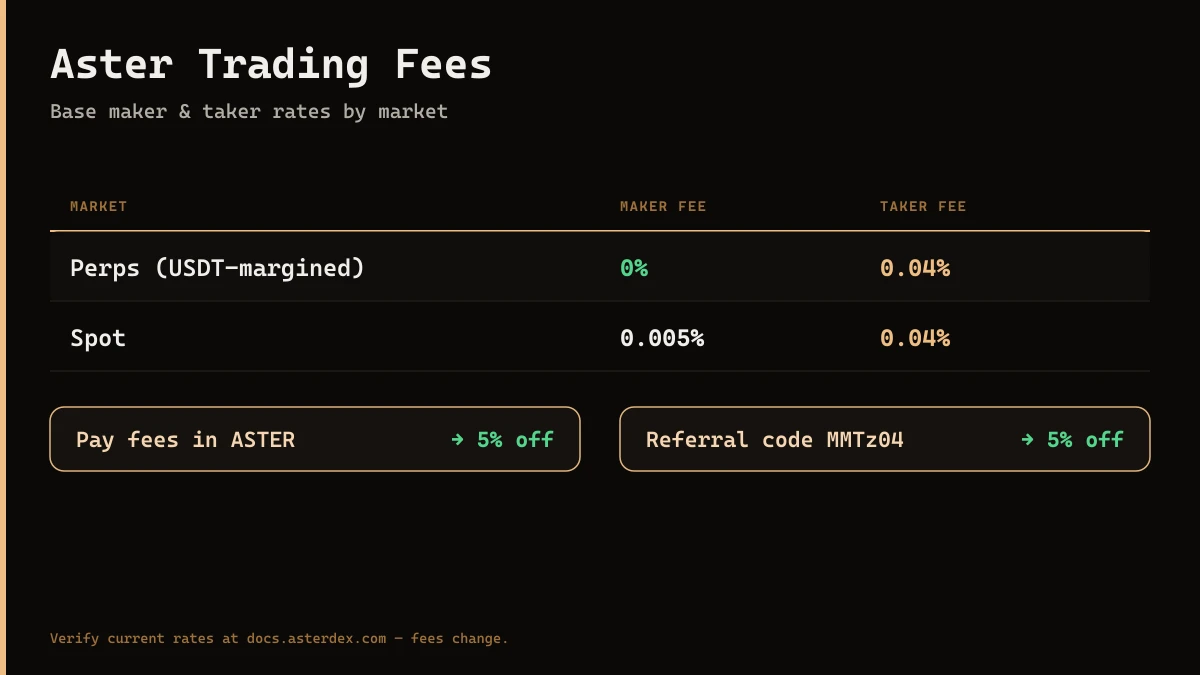
| Market | Maker fee | Taker fee | Notes |
|---|---|---|---|
| Perps (USDT-margined) | 0% | 0.04% | Resting limit orders pay nothing |
| Perps (USD1-margined) | 0% | 0.005% | Lower taker on USD1 collateral |
| Spot (order-book) | 0.005% | 0.04% | e.g. ASTERUSDT |
| 1001x (standard) | n/a | n/a | ~0.08% open + 0.08% close on notional |
| 1001x (500x–1001x tier) | n/a | n/a | No open fee; dynamic close fee on PnL (min ~0.03%) |
Info
These are point-in-time figures taken from Aster's official fee documentation. Older docs cited 0.01% / 0.035% on perps; treat the current fee page (0% / 0.04%) as authoritative and verify the live rates in the app before you size a trade. Aster ships fast and revises fees periodically.
The headline takeaway: Aster's maker fee on perpetuals is zero. If you trade with resting limit orders that add liquidity to the book, you pay nothing on the perp side. Zero is as low as a maker fee goes, and it shapes the cheapest way to trade here, which we cover in the fee-minimization section below.
What does Aster charge for maker and taker orders?
Perps are Aster's flagship product, covering crypto pairs plus contracts that track equity and commodity prices. Those equity and commodity perps trade 24/7 and settle in USDT; they reference price feeds supplied by third-party oracle providers rather than giving you the underlying share or barrel. The fee model is the standard maker/taker split:
- Maker (0%). You post a limit order that rests in the order book and waits to be filled. You are adding liquidity, so Aster charges nothing on USDT-margined pairs.
- Taker (0.04%). You hit an existing order with a market order or a marketable limit, removing liquidity. You pay 0.04% of the position's notional value.
A worked example makes it concrete. Open a $10,000 notional BTC perp position as a taker and the fee is $10,000 × 0.0004 = $4. Open the same position as a maker, meaning a limit order that rests and gets filled, and you pay $0. Round-trip that taker position (open and close, both as taker) and you've spent $8; round-trip it entirely as a maker and you've spent nothing on trading fees. Funding payments are separate from trading fees and still apply to any perp you hold across funding intervals, and what funding has actually cost on each market over the past 30 and 90 days is recorded separately.
If you margin with USD1 instead of USDT, the taker rate drops to 0.005%, though USDT remains the primary collateral most traders use. USD1 is a stablecoin issued by a third party, not by Aster, so its backing and redemption terms are that issuer's to answer for. Whichever collateral you pick, the maker side stays at 0%. Aster also accepts tokenized equity products as collateral, including tokens tracking Tesla and Nvidia shares, which are issued by third parties rather than by Aster or those companies. The equity perps themselves trade at 0% maker and 0.009% taker.
On Aster perps, how you enter matters as much as what you trade. Maker orders cost nothing; taker orders cost 0.04% of notional each way. Patient, limit-order traders can run a near-zero-fee operation on the perp side.
What does spot trading cost on Aster?
Aster also runs an order-book spot market (for example, ASTERUSDT). Spot fees follow the same maker/taker logic but with slightly different numbers:
- Maker: 0.005%. Unlike perps, spot makers pay a small fee: $0.50 on a $10,000 trade.
- Taker: 0.04%. The same 0.04% taker rate as perps, or $4 on a $10,000 trade.
Spot is where you'd buy and hold the ASTER token outright rather than gain leveraged exposure through a perp. Because there's no leverage, the absolute fees on a given dollar amount of exposure are higher than a leveraged perp position controlling the same notional. A spot position bought outright is also not subject to liquidation and does not pay funding. On perps, a forced close carries its own fee on top of the rates above; see how liquidation works on Aster for what the docs and the API say about it.
How is the 1001x fee model priced?
Aster's 1001x mode, which Aster describes as a fully on-chain, MEV-resistant, one-click leverage product on select pairs like BTC and ETH, uses a different fee model than the order book. Instead of a maker/taker split, it charges open and close fees on notional, and the structure changes at the highest leverage tiers:
- Standard 1001x tiers. Roughly 0.08% to open + 0.08% to close, calculated on the position's notional value. On a $10,000 position that's about $8 in and $8 out.
- Very high leverage (≈500x–1001x). No opening fee. Instead, Aster applies a dynamic closing fee on your realized PnL, with a stated minimum around 0.03%. You pay on the way out, scaled to what you made.
- Network execution fee. 1001x runs on-chain via the ALP pool on BNB Chain and Arbitrum, so each execution carries a network cost of roughly $0.50 on BNB and $0.20 on Arbitrum. That is gas paid to chains Aster does not operate, so it moves with network conditions rather than with Aster's fee schedule.
Info
The 1001x fee model is the part of Aster's schedule that changes most. The PnL-based closing fee, the tier thresholds, and the network costs can all shift between product updates. Before opening a high-leverage position, read the current 1001x fee terms inside the app rather than relying on a static figure.
The practical effect of that structure: at those tiers you pay nothing to open, and the cost lands on exit scaled to realized profit rather than to the notional the position controls. On a 1001x position the notional can be very large relative to your margin, so which basis the fee uses matters.
Trade Aster with a 5% fee rebate
Sign up with code MMTz04 and, under Aster's documented referral terms, 5% of the trading fees you pay is credited back to you daily. Separate from the 5% pay-in-ASTER discount.
Trade on AsterTwo ways to pay less
There are two separate perks, and they work differently. One is a discount taken when you trade. The other is a rebate Aster credits back afterward.
1. Pay your fees in ASTER (5% discount)
Inside the Aster app there's a toggle to pay trading fees in the native ASTER token. Flip it on and Aster's fee documentation puts the reduction at 5% on perp and spot fees. It applies at the point of trade, so the fee you are charged is already lower. It also gives traders a reason to hold a small ASTER balance, which feeds the token economy: a June 2026 upgrade directs the vast majority of daily platform fees toward ASTER buybacks for veASTER stakers. We break down how that loop works in our Aster buyback and burn tokenomics guide.
2. Referral code MMTz04 (5% fee rebate)
This one is a rebate, not a discount, and the difference matters. Per Aster's documented referral program terms, a referred user gets nothing by default: the referrer earns a 10% commission on the referred user's trading fees and can choose to pass part of it back. Asterpedia's account is set to a 5/5 split, so you get 5% of the trading fees you pay back as a rebate. Aster calculates it daily at 00:00 UTC and credits it the next day in the asset the fee was paid in, and per those same terms the referral is valid for 365 days. To activate it, register on asterdex.com with the referral applied. Program terms are Aster's to set and change, so read them on the docs page rather than taking this description as a guarantee. For a walkthrough of applying the code at sign-up, see our dedicated Aster referral code page.
Can you use both discounts at the same time?
The two work on different parts of the flow. The pay-in-ASTER discount lowers the fee you are charged; the referral rebate credits back 5% of whatever you did pay. Run both and the rebate is calculated on the already-discounted amount, so they compound rather than simply adding up.
Two separate mechanisms: pay-in-ASTER takes 5% off at the point of trade, and referral code MMTz04 credits back 5% of the fees you pay, per Aster's documented program terms. The rebate arrives a day later in the fee asset, calculated on what you paid after the discount.
How do you pay less in fees on Aster?
Putting it all together, here's a practical playbook for paying as little as possible:
- Sign up with the referral code. Register on the Aster app with code MMTz04 for the 5% fee rebate, valid 365 days per Aster's program terms. Do it before your first trade, since those terms apply the referral at sign-up rather than retroactively.
- Toggle on pay-in-ASTER. Hold a small ASTER balance and enable the fee toggle for 5% off perp and spot fees at the point of trade.
- Trade as a maker whenever you can. On USDT-margined perps the maker fee is 0%. Posting resting limit orders instead of market-buying means you pay nothing on the perp leg. This is the biggest lever on your fee bill.
- Use limit orders on spot too. Spot makers pay 0.005% versus 0.04% for takers, an 8x difference. If you're not in a hurry to fill, set a limit.
- Mind the 1001x close fee. On extreme-leverage positions the cost lands on the way out and scales with your PnL. Factor that into your exit, and remember the per-execution network fee.
- Right-size your frequency. Even small per-trade fees compound across hundreds of round trips. Fewer, better-sized takers often beat constant churn.
Consider a trader running $10,000 notional perp positions purely as a taker, 20 round trips a day. Gross taker fees come to 20 × 2 × $4 = $160/day. The pay-in-ASTER discount takes that to about $152, and a 5% rebate on the $152 credits roughly $7.60 back the next day, for a net near $144/day, or about $480 a month. Shift those entries to maker orders where possible and the perp trading fee approaches zero. Order type is the bigger lever.
Info
Every figure in this article is a 2026 snapshot. Aster's fee schedule, discount percentages, and the 1001x model change with product updates. The authoritative source is the live fee page in the Aster app and the official docs, so verify current rates there before trading.
How Aster's fees compare conceptually
We won't quote competitor numbers here, since they move as fast as Aster's, but it's worth understanding where Aster sits. Many order-book and on-chain perp venues charge something on both sides of the book. On Aster's USDT-margined perps, the maker side is zero, and zero is the floor.
The taker rate of 0.04% is ordinary for the category. What is layered on top is the pay-in-ASTER discount and the referral rebate, both of which reduce what you actually pay against an already low base. For a feature-by-feature breakdown against the largest on-chain perp venue, see our Aster vs Hyperliquid comparison. And because a rate card only ever quotes one side of a position, our Perp DEX Fee Index works out what a full round trip costs on four venues at three trade sizes, which is the number that comes out of your account.
The 1001x model is the other thing worth understanding. Charging a PnL-based closing fee at extreme leverage instead of a flat notional fee is unusual, and whether it is cheaper for you depends on your win rate and position sizing. Read the live terms before using it.
Bottom line
Aster's fee story in 2026 is straightforward: zero maker fees on perps, a modest 0.04% taker, low spot rates, and an unconventional 1001x model that bills on PnL at the top leverage tiers. Add the 5% pay-in-ASTER discount and the 5% referral rebate on code MMTz04 and an organized trader can run a low-cost operation. If you're new to the platform, start with our getting-started trading guide and browse the wider Aster ecosystem to see how the token and fee mechanics fit together. If a deposit you make to cover those fees does not appear at first, our guide on a deposit not showing up on Aster covers the fixes. Confirm the current numbers in the app before you trade; on Aster, the one constant about fees is that they keep changing.
Start trading on Aster with a 5% fee rebate
Use referral code MMTz04 and Aster credits back 5% of the trading fees you pay, then toggle pay-in-ASTER for a 5% discount at the point of trade. Verify live rates in the app.
Trade on AsterFrequently Asked Questions
On USDT-margined perpetuals, Aster charges a 0% maker fee and a 0.04% taker fee at the base tier. That means resting limit orders that add liquidity pay nothing, while market orders that remove liquidity pay 0.04% of notional. Fees change often, so confirm the current schedule in the Aster app or docs before sizing a trade.
They are two separate things and both can apply. Paying your fees in ASTER carries a 5% discount at the point of trade, per Aster's fee documentation. The referral program works differently: per Aster's documented program terms the referrer earns a 10% commission on a referred user's fees and can choose to pass part of it back, and this site's code MMTz04 is set to a 5/5 split, so referred users get 5% of the trading fees they pay back as a rebate. Aster calculates it daily at 00:00 UTC and credits it the next day in the asset the fee was paid in. Because the rebate is calculated on fees actually paid, it applies to what is left after any discount.
Aster's published terms put standard 1001x trades at roughly a 0.08% open and 0.08% close fee on notional. On the very high leverage tiers from about 500x up to 1001x, the opening fee is waived and a dynamic closing fee is charged on realized profit, with a stated minimum around 0.03%, plus a per-execution network fee paid to the underlying chain. These terms change between product updates, so verify the live model in-app before opening a position.
Yes. Order-book spot trading on Aster carries a 0.005% maker fee and a 0.04% taker fee at the base tier. As with perps, paying in ASTER reduces the fee at the point of trade and a referral rebate credits part of it back afterward. Treat these figures as a snapshot and re-check current rates in the app.
Aster ships product updates quickly and periodically revises its fee schedule, discount mechanics, and the 1001x model. Any published figure is a point-in-time snapshot. The authoritative source is always the live fee page in the Aster app and the official documentation, so verify before you trade.
Sources & Citation
How these figures were verified
- Aster official documentation: perpetual fees — maker and taker rates on USDT-, USD1- and stock-margined perpetuals, and the 5% pay-in-ASTER discount. Checked .
- Aster official documentation: Referral Program — the 10% referrer commission, the referrer-set split that produces the 5% referee rebate, the daily 00:00 UTC calculation and next-day credit in the fee asset, and the 365-day referral validity. Checked .
- Aster app: live fee schedule and 1001x terms — the 1001x open and close fee tiers, the PnL-based closing fee at the highest leverage tiers, and the per-execution network fee, all of which are shown in-app and change between product updates. Checked .
- Asterpedia — the worked cost examples and the effective rates after the pay-in-ASTER discount and the referral rebate, calculated from the published rates above. Checked .
Aster revises its fee schedules, leverage caps and token mechanics regularly, so every figure here is a dated snapshot rather than a live feed. Where a number comes from Asterpedia’s own tracking rather than the documentation, it is labelled as such above.
Cite this page
Asterpedia. "Aster Fees Explained: Perps, Spot, 1001x & ASTER Discounts (2026)." Published June 23, 2026; last updated August 18, 2026. https://asterpedia.com/guides/fees/aster-fees-explained<a href="https://asterpedia.com/guides/fees/aster-fees-explained">Aster Fees Explained: Perps, Spot, 1001x & ASTER Discounts (2026)</a> — Asterpedia, updated August 18, 2026Reuse
You may republish these figures with attribution and a link to https://asterpedia.com/guides/fees/aster-fees-explained.
Asterpedia is an independent, unofficial resource. It is not affiliated with, produced by, reviewed by, endorsed by or sponsored by Aster, asterdex.com, their operators, or their backers including YZi Labs. "Aster", "ASTER" and the Aster logo are trademarks of their respective owners, used here for identification only.
Disclaimer: Nothing here is financial, investment, legal or tax advice. Trading perpetual futures carries a substantial risk of loss. Whether any product described here is lawful or appropriate where you live, and how any trade is taxed, depends on your jurisdiction and your circumstances. Check the primary sources and speak to a qualified professional. This site contains referral links, and the full disclosure is in the site footer.
Ready to Start Trading?
Sign up to Aster with referral code MMTz04 and 5% of your trading fees come back to you as a rebate. Connect a wallet and you are trading in minutes.
Trade on Aster - 5% Fee Rebate