Aster vs Hyperliquid (2026): Which Perp DEX Is Better?
Fees and rules are checked against Aster's documentation at docs.asterdex.com, and live market figures come from Aster's public API. How we verify
Table of Contents
- Quick verdict up front
- Side-by-side comparison
- Privacy: hidden encrypted orders vs a public book
- Leverage: 1001x versus much lower caps
- Market coverage: 24/7 stocks and commodities
- Deposits and collateral: multi-chain and yield-bearing
- Fees: both competitive, different models
- Backers and track record
- Token models: ASTER vs HYPE
- Which should you choose?
 Astervs
 Hyperliquid
Aster and Hyperliquid are two of the most talked-about decentralized perpetual exchanges heading into 2026, and traders keep asking the same thing: which one is actually better? The honest answer is that they are built differently. Hyperliquid is a crypto-native order book running on its own purpose-built blockchain, with every order public. Aster is a privacy-oriented, multi-chain venue that pushes leverage, market breadth and yield-bearing collateral further than most rivals.
This guide compares them on privacy, leverage, market coverage, deposit flexibility, fees, backers and token design, then ends with a verdict on which trader should pick which platform. Figures for Aster come from Aster's own documentation, and figures for Hyperliquid come from Hyperliquid's, both dated in the sources section at the foot of this page. Where we could not verify something from a primary source, we say so rather than filling in the gap.

Quick verdict up front
If you want concealed order flow, high leverage and exposure to stocks and commodities alongside crypto, Aster is the stronger fit. If you prize a public on-chain order book, a longer public track record and deep crypto-only liquidity, Hyperliquid is hard to beat. Both are self-custodial, and neither currently asks you to verify your identity before trading, though whether either venue is available or appropriate where you live is a question for your own jurisdiction. This is not a case of one good product and one bad one.
Aster differentiates on privacy (hidden encrypted orders), leverage (up to 1001x), 24/7 stock and commodity perps, native deposits from several chains, and yield-bearing collateral. Hyperliquid differentiates on a fully public order book, its own high-performance L1, and a longer crypto-trading track record. The "better" DEX depends on which of those you weight most.
Side-by-side comparison
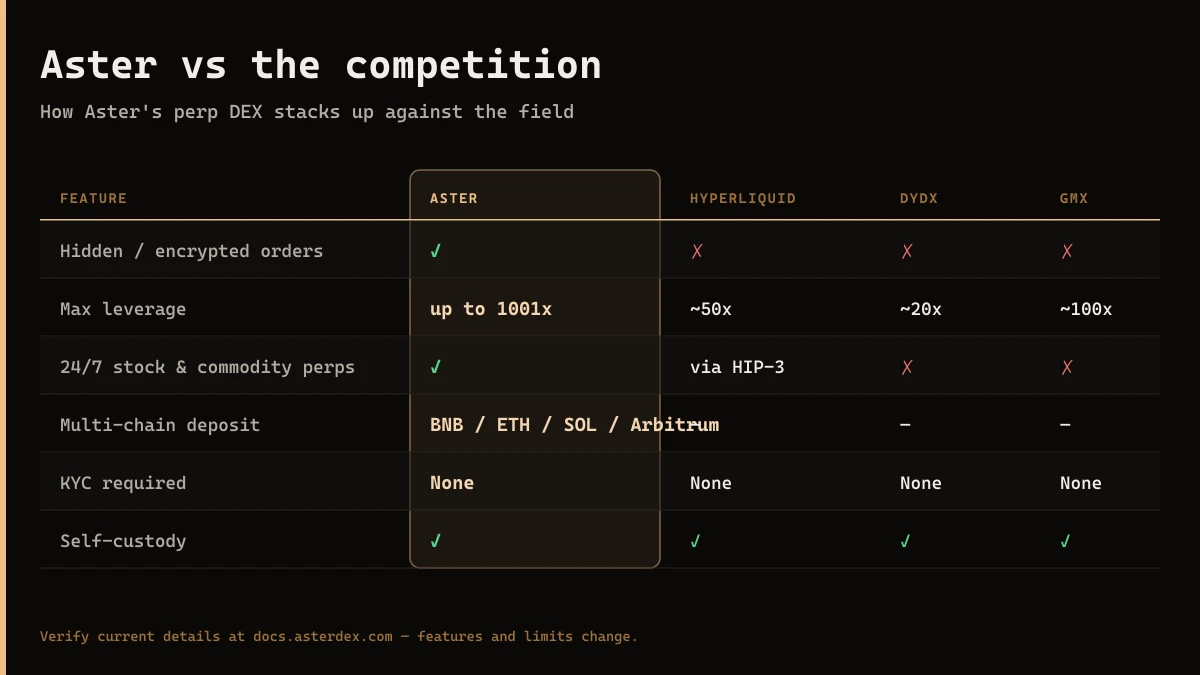
| Aster | Hyperliquid | |
|---|---|---|
| Exchange type | Multi-chain privacy-focused perp DEX | Perp DEX on its own purpose-built L1 |
| Privacy / hidden orders | Encrypted orders, not shown in the public book | Public on-chain order book |
| Max leverage | Up to 1001x on select pairs (BTC/ETH) | Lower per-market caps; see its own docs |
| Stock & commodity perps | Yes, 24/7, settled in USDT, priced by Pyth | Crypto-focused |
| Deposit chains | BNB Chain, Ethereum, Solana, Arbitrum | Bridge to its own L1 (USDC) |
| Fees (perps) | Maker 0% / taker ~0.04% (USDT margin) | Maker/taker with 14-day volume tiers |
| Native token | ASTER: fee discount, veASTER, buyback & burn | HYPE: fees, staking, governance |
| Identity verification to trade | Not requested as of August 2026 | Not requested as of August 2026 |
| Self-custody | Yes, non-custodial | Yes, non-custodial |
The identity row describes what each app asks for at the point of trading, on the date shown. It is not a statement about either venue's regulatory position, and it says nothing about your own obligations. Whether you may lawfully use either platform, and how any resulting gain or loss is treated for tax, depends on where you live. Check the primary sources and speak to someone qualified in your jurisdiction.
Privacy: hidden encrypted orders vs a public book
This is the biggest visible split between the two platforms.

Hyperliquid runs a public on-chain order book. Orders, positions and liquidations are visible to anyone watching the chain. For many traders this is a feature rather than a flaw, because it means you can independently verify the book, audit fills and confirm for yourself that matching is not happening somewhere you cannot see. That openness is one of Hyperliquid's strongest selling points and a big reason it earned trust.
Aster takes the other route. Its hidden encrypted orders are encrypted before they reach the chain and decrypted at the moment of execution, so as the feature is currently implemented they do not appear in the public order book. The practical effect is less exposure to position-hunting and MEV: a bot has much less to work with when it cannot read your resting size, and other traders have a harder time targeting a liquidation level they cannot infer from the book. Aster pairs this with Shield Mode, a simplified interface with privacy built in, and is building a privacy-focused L1 (Aster Chain) with account privacy and ZK-verifiable encrypted orders.
Verifiability at the book level is a different question from verification at the contract level, and the two venues publish different amounts of the latter. On Aster's side, seven audit reports cover the vault and Earn contracts and none covers the perpetuals engine itself, which we go through report by report in what Aster's security audits actually found.
Neither approach is objectively correct. A public book favors verifiability; concealed orders favor the trader who does not want their hand shown. If you trade size and care about not telegraphing your positions, Aster's model is a meaningful edge. If you want to audit everything yourself, Hyperliquid's openness is exactly what you want.
It is worth being precise about what each model does and does not give you. A public book does not make Hyperliquid "unsafe", it makes the venue checkable. Encrypted orders on Aster do not make the venue opaque about its own operations either, since the matching logic is still deterministic; it is your specific orders that stay concealed from other participants until they fill. So the real question is whose visibility you care about: the exchange's, which favors Hyperliquid, or your counterparties', which favors Aster.
Info
Privacy and transparency are a genuine trade-off, not a marketing gimmick. Concealed orders reduce how easily large traders can be hunted; an open book lets anyone verify the exchange. Decide which property you actually need before choosing.
Leverage: 1001x versus much lower caps
On headline leverage the gap is wide. Hyperliquid publishes per-market caps that sit far below Aster's ceiling, and those caps are set market by market, so read them off Hyperliquid's own documentation rather than any summary, including this one.
Aster goes much further. Through its Simple and 1001x modes, it offers up to 1001x leverage on select high-liquidity pairs such as BTC and ETH. These positions run fully on-chain with one-click execution, no initial margin on the 1001x flow, and MEV resistance. On standard Pro perps, crypto leverage sits around 100x per pair, with stock perps around 50x or lower. Our 1001x leverage explained guide walks through how this works and, just as importantly, the liquidation risk involved; the margin tiers and the liquidation engine itself are covered in how liquidation works on Aster.
To be clear: 1001x is not a number most traders should use most of the time. Higher leverage means a tighter liquidation band and faster wipeouts. The point is optionality. Aster lets experienced traders reach for extreme leverage when they want it, while lower caps elsewhere mean a wider margin for error. Both settings are defensible.
Aster's up-to-1001x leverage is a genuine differentiator for advanced traders who understand the liquidation math. A lower ceiling elsewhere is not a weakness, it is a different risk setting. Match the platform to your appetite, not to the bigger number.
Trade Aster with a 5% fee rebate
Sign up with referral code MMTz04 and, under Aster's documented referral program terms, 5% of your trading fees comes back to you as a rebate.
Start Trading on AsterMarket coverage: 24/7 stocks and commodities
Hyperliquid is crypto-focused. It is built around deep, liquid digital-asset perpetuals, and it does that very well. If your entire trading universe is crypto majors and altcoins, that focus works in your favor, because liquidity is concentrated where you need it.
Aster widens the aperture. Beyond crypto perps and spot, it lists 24/7 perpetuals on stocks and commodities, settled in USDT. Those contracts are priced from feeds published by Pyth, a third-party oracle network, rather than from a price Aster sets itself. Because they trade around the clock, you can take equity or commodity exposure on a weekend or overnight, which traditional market hours do not allow. For a trader who wants crypto, equity-tracking and commodity exposure in one self-custodial account, that breadth is hard to match. Availability and suitability still depend on your jurisdiction.
One is a specialist and the other is a generalist. Specialists tend to win on depth in their niche; generalists win on reach.
Deposits and collateral: multi-chain and yield-bearing
Getting funds onto each venue differs in a way that matters for everyday use.
Hyperliquid centers on bridging assets (typically USDC) onto its own L1, where all trading then happens. It is clean and purpose-built, and it is a single-destination model.
Aster is multi-chain native. You can deposit from BNB Chain, Ethereum, Solana or Arbitrum with no manual bridging, using wallets like  MetaMask, Binance Wallet or Phantom. Our how to trade on Aster guide covers the full flow. Aster also supports yield-bearing collateral, so assets like asBNB and USDF can sit as margin while still earning, and it accepts tokenized stocks issued by third parties as collateral, which lets equity-tracking tokens back a perp position. Pro mode adds multi-asset margin and portfolio risk tools on top.
For traders already spread across several chains, Aster's deposit flexibility removes friction. For those who prefer a single, self-contained environment, Hyperliquid's focused design is appealing.
Tip
If you hold assets across BNB Chain, Ethereum, Solana and Arbitrum, Aster's native multi-chain deposits save you bridging steps. Yield-bearing collateral means your margin can keep earning while it backs positions.
Fees: both competitive, different models
Both platforms are cost-competitive. Neither is a fee trap.
Hyperliquid uses a maker/taker structure with volume tiers and a staking reduction. Its own fee documentation listed 0.015% maker and 0.045% taker at the base tier when we read it on August 14, 2026, with rates falling as 14-day volume passes $5M and a further 5% reduction for staking HYPE at the entry tier. Those are Hyperliquid's published numbers, not our estimate, and they are the kind of figure a venue revises, so check the live page before relying on them.
Aster's perp fees are also lean: on USDT-margined perps, Aster's documentation lists 0% maker and 0.04% taker, with lower taker fees on certain margin types. Two separate perks apply on top. Paying fees in ASTER gives a documented 5% fee discount. Separately, signing up under referral code MMTz04 routes 5% of your trading fees back to you as a rebate under Aster's documented referral program terms, credited by Aster after the fact rather than deducted at the point of trade. The full breakdown lives in our Aster fees explained guide, including the separate fee schedule for 1001x positions, and the fees section of the site collects everything on how Aster's fee tiers actually work alongside the two discounts.
Rate cards quote one side of a trade, though, and a position has two. Using the published base-tier rates above, opening and closing at market costs 0.08% of notional on Aster against 0.09% on Hyperliquid, which on a $10,000 position is $8.00 against $9.00. Our Perp DEX Fee Index runs that arithmetic across four venues and three trade sizes, with the exclusions spelled out.
Backers and track record
Here the platforms diverge again, and reasonable people weigh this differently.
Hyperliquid is widely described in the market as community-funded rather than VC-backed, and many traders treat that as a point of alignment. We have not verified its funding history against a primary source, so read that as reputation rather than as a documented fact you should rely on. What is easier to observe is its record as one of the most-used perp DEXs, operating at scale through volatile conditions.
Aster's own launch materials set out a different origin. They describe the platform as formed from the 2024 merger of Astherus (yield) and APX Finance (perps), backed by YZi Labs (formerly Binance Labs), advised by Binance founder CZ, and built by a team with Binance experience. YZi Labs is described there as a backer, not an operator, and Aster names no legal entity in its published terms. Coverage in September 2025 reported that Aster briefly passed Hyperliquid in daily perp volume around its token launch. Pedigree and a multi-year public track record are different forms of credibility, and the two platforms lean on different ones.
Token models: ASTER vs HYPE
Both have a native token central to the platform, with broadly similar utility but different specifics.
Hyperliquid's HYPE is used for fees, staking and governance, and is tightly integrated with the L1.
Aster's ASTER token launched at its TGE in September 2025. Per Aster's documentation it gives a 5% fee discount when fees are paid in ASTER, powers veASTER staking (loyalty rewards and a share of buybacks scaled by lock length), and feeds a buyback-and-burn mechanism: a June 2026 upgrade directs 99% of daily platform fees toward ASTER buybacks for veASTER stakers, with an equal amount burned bi-weekly as supply trends toward a 3B target. That ties token value to platform fee revenue, which only works as an alignment story while Aster's volume holds.
As always with tokens, treat published mechanics as descriptive rather than as financial advice, and verify current supply and burn figures before acting on them. Nothing here is a view on how any token should be classified or treated where you live. If you want to trade the comparison rather than read about it, both tokens are listed as perps on Aster: the ASTER market itself runs at up to 50x, and HYPE is on the same book.
Both tokens drive fee discounts, staking and alignment. ASTER's standout feature is its fee-funded buyback-and-burn, which routes the large majority of daily platform fees back to stakers and toward supply reduction, tying value capture to how much the exchange is used. For the full mechanism, including the matching burn and the 97% emission cut, see our Aster buyback and burn tokenomics breakdown.
Which should you choose?
There is no universal winner, so match the platform to what you actually value.
Choose Aster if you want:
- Privacy. Hidden encrypted orders that reduce your exposure to position-hunting and MEV.
- Extreme leverage. Up to 1001x on select pairs, with the discipline to manage it.
- Broader market coverage. 24/7 stock and commodity perps alongside crypto, priced by third-party oracles.
- Multi-chain convenience. Native deposits from four chains and yield-bearing collateral.
- Aggressive token economics. Fee-funded ASTER buybacks and burns.
Choose Hyperliquid if you want:
- A public book. Every order visible and verifiable on-chain.
- A long track record. One of the longest-running, most-used perp DEXs at scale.
- Crypto-native depth. Concentrated liquidity in a focused, specialist venue.
- A purpose-built L1. Trading on infrastructure built solely for it.
- Its funding story. A widely cited community-funding reputation, if that alignment matters to you.
Plenty of active traders use both: Hyperliquid for public, deep crypto execution and Aster when they want privacy, higher leverage or non-crypto markets. They are not mutually exclusive, and trying each with small size is the surest way to find your fit. If Aster's privacy, leverage and market breadth line up with how you trade, the getting-started guide will get you from wallet to first trade in minutes.
Ready to trade on Aster?
Use referral code MMTz04 to receive 5% of your trading fees back as a rebate under Aster's program terms, alongside the separate 5% discount for paying fees in ASTER. Self-custodial, four deposit chains.
Trade on Aster with MMTz04Frequently Asked Questions
Neither is strictly better, because they are built for different jobs. Aster offers hidden encrypted orders, leverage up to 1001x on select pairs, 24/7 stock and commodity perps, and deposits from several chains. Hyperliquid runs a public on-chain order book on its own L1 and has a longer public track record in crypto markets. Choose based on whether you want concealed order flow and broader market coverage, or a book you can audit yourself.
Aster documents up to 1001x on select pairs such as BTC and ETH through its Simple and 1001x modes, with standard Pro crypto perps around 100x per pair and stock perps around 50x or lower. Hyperliquid sets its own per-market caps, which are lower; check Hyperliquid's own documentation for current figures rather than relying on a third-party summary. Caps on both venues change without notice.
Hyperliquid runs a public on-chain order book, so resting orders and positions can be read by anyone watching the chain, which many traders value for verifiability. Aster takes a different route: orders are encrypted before they reach the chain and decrypted at execution, so as currently implemented they do not show up in the public book. That is the main privacy difference between the two.
Aster lists 24/7 perpetuals on stocks and commodities settled in USDT, with prices supplied by the third-party Pyth oracle network rather than set by Aster. Hyperliquid is centered on digital-asset perpetuals. Whether products like these are available or appropriate where you live depends on your jurisdiction, and so does how any trade is taxed.
Aster's own launch materials describe the platform as formed from the 2024 merger of Astherus and APX Finance, backed by YZi Labs (formerly Binance Labs), advised by Binance founder CZ, and built by a team with Binance experience. YZi Labs is described there as a backer rather than an operator. Aster names no legal entity in its published terms, so treat the corporate structure as undisclosed.
Sources & Citation
How these figures were verified
- Aster official documentation (Perpetuals: Fees) — Aster's maker and taker rates on USDT-margined perps and the 5% pay-in-ASTER fee discount. Checked .
- Aster official documentation (Referral Program) — the referral program terms, including that the rebate is paid after the fact rather than deducted at the point of trade. Checked .
- Hyperliquid official documentation (Fees) — Hyperliquid's base-tier maker and taker rates, its volume tiers, and the HYPE staking reduction. Checked .
- Aster official documentation ($ASTER Tokenomics) — the buyback-and-burn mechanism, the share of daily fees directed to it, and the supply target. Checked .
- Asterpedia — the round-trip cost comparison, calculated from each venue's published rates above. Checked .
Aster revises its fee schedules, leverage caps and token mechanics regularly, so every figure here is a dated snapshot rather than a live feed. Where a number comes from Asterpedia’s own tracking rather than the documentation, it is labelled as such above.
Cite this page
Asterpedia. "Aster vs Hyperliquid (2026): Which Perp DEX Is Better?." Published June 23, 2026; last updated August 18, 2026. https://asterpedia.com/compare/aster-vs-hyperliquid<a href="https://asterpedia.com/compare/aster-vs-hyperliquid">Aster vs Hyperliquid (2026): Which Perp DEX Is Better?</a> — Asterpedia, updated August 18, 2026Reuse
You may republish these figures with attribution and a link to https://asterpedia.com/compare/aster-vs-hyperliquid.
Asterpedia is an independent, unofficial resource. It is not affiliated with, produced by, reviewed by, endorsed by or sponsored by Aster, asterdex.com, their operators, or their backers including YZi Labs. "Aster", "ASTER" and the Aster logo are trademarks of their respective owners, used here for identification only.
Disclaimer: Nothing here is financial, investment, legal or tax advice. Trading perpetual futures carries a substantial risk of loss. Whether any product described here is lawful or appropriate where you live, and how any trade is taxed, depends on your jurisdiction and your circumstances. Check the primary sources and speak to a qualified professional. This site contains referral links, and the full disclosure is in the site footer.
Ready to Start Trading?
Sign up to Aster with referral code MMTz04 and 5% of your trading fees come back to you as a rebate. Connect a wallet and you are trading in minutes.
Trade on Aster - 5% Fee Rebate