Aster Buyback & Burn: The Fee-to-Token Tokenomics, Explained (2026)
Fees and rules are checked against Aster's documentation at docs.asterdex.com, and live market figures come from Aster's public API. How we verify
Table of Contents
- Where does the "198%" figure come from?
- What changed on June 17, 2026?
- Why are the buyback and the burn counted separately?
- Flow 1: Fees → Buyback → veASTER Stakers
- Flow 2: Matching Burn → Supply Reduction
- How does the 97% emission cut fit in?
- What do you have to do to receive a share of the buyback?
- What This Means If You Trade or Hold
- If you trade on Aster
- If you hold ASTER
- If you stake as veASTER
- Tying it to volume
- The Mechanism at a Glance
Aster's 2026 tokenomics wire the buyback into the exchange's fee plumbing: per its own documentation, nearly every dollar the platform collects in fees is spent buying back the ASTER token, and a matching amount is destroyed on a schedule. If you trade or hold on Aster, that changes the math on both sell pressure and staking rewards.
This guide walks through how the mechanism works rather than rehashing the headline. We cover the June 17, 2026 buyback upgrade, the separate emission cut that came earlier in the year, how the burn and the staking rewards are two different flows, and what each one does for someone holding or trading the token. No price predictions and no financial advice.
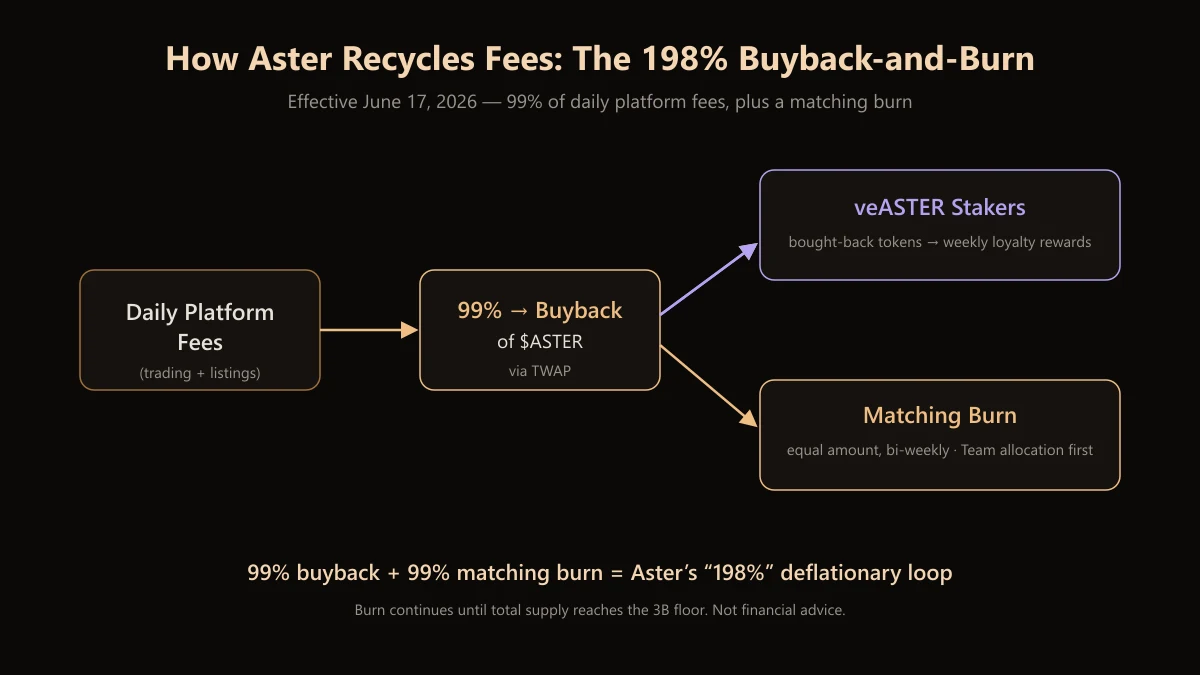
Aster's documentation says that from June 17, 2026 it directs 99% of daily platform fees into ASTER buybacks via TWAP, with the bought-back tokens going to veASTER stakers, and burns an amount equal to those buybacks every two weeks, drawing from the team allocation first. Aster labels the combined effect "198%" (99% bought back plus 99% burned). A separate change earlier in 2026 cut new token emissions by about 97%.
Where does the "198%" figure come from?
It is Aster's own shorthand for 99% plus 99%. Ninety-nine percent of daily platform fees buy ASTER back on the open market, and an amount of ASTER equal to that buyback is burned from reserves. Add the two together and you get the 198% headline. It is not a dollar amount, not an annualized yield, and it does not mean buybacks exceed emissions by 198%.
Broken out:
- 99% of daily platform fees are used to buy back ASTER on the open market.
- An amount of ASTER equal to that buyback (another 99%) is burned from reserves.
Add the buyback pressure and the burn pressure together and you get the 198% headline. It is not a dollar amount or an annualized yield, and it does not mean buybacks exceed emissions by 198%. Whenever you see the figure quoted, read it as Aster's label for 99% buyback plus a matching 99% burn.
Warning
"198%" is a description of a mechanism, not a return. A protocol can run an aggressive buyback-and-burn and still see its token fall if demand drops or fee volume shrinks. Treat the number as context for how fees are recycled, not as a yield figure. Nothing in this article is financial advice.
What changed on June 17, 2026?
Aster raised the share of daily platform fees routed into buybacks to 99% and formalized the matching burn, effective June 17, 2026 at 12:00 UTC per its tokenomics documentation. Before that the buyback captured a smaller slice of fees; the up-to-80% figure still quoted in some explainers is stale. Purchases execute on a time-weighted average price rather than as one market order.
Two details matter for how the buyback behaves in the market:
- It uses TWAP. The docs give time-weighted average price as the execution method, so purchases are spread across a window rather than sent as a single market order. How much that softens market impact on any given day depends on conditions.
- There are two fee sources, not one. The daily fee buyback is the main channel. Per the same docs, Aster also charges a 50,000 USDT permissionless spot listing fee, and that revenue is routed into additional ASTER buybacks, so new listings feed the engine too.
Why are the buyback and the burn counted separately?
Because they have different destinations. The 99% of fees buys ASTER on the open market and those purchased tokens go to veASTER stakers as rewards. The matching burn is funded separately, drawing from reserves, and destroys an equal amount on a bi-weekly schedule. Same size, different jobs: one pays lockers, the other shrinks the float. Most summaries blur the two together.
Flow 1: Fees → Buyback → veASTER Stakers
The 99% of daily fees buys ASTER on the open market, and those purchased tokens are distributed to veASTER stakers. Each weekly epoch, per Aster's docs, the bought-back ASTER is added to the loyalty reward pool on top of a base loyalty reward of 300,000 ASTER. The bought-back tokens go to lockers; the burn is funded separately.
Flow 2: Matching Burn → Supply Reduction
Separately, an amount of ASTER equal to the buyback is burned on a bi-weekly schedule. Aster's documentation states that the burn draws from the team allocation first. Those tokens leave circulation, moving total supply toward the 3 billion floor the docs describe. This site has no visibility into who controls that allocation or how the order is enforced, so the burn order is Aster's stated policy rather than something we can verify.
So one flow rewards lockers and the other reduces the float. They are funded in equal measure (that is the "198%"), but they do different jobs. If you only remember one thing: buybacks go to stakers, the burn comes out of reserves.
The buyback (99% of fees) rewards veASTER stakers with purchased tokens. The burn (a matching 99%) destroys an equal amount from reserves, which Aster's docs say draws from the team allocation first. Same size, different destinations. Conflating them is the most common mistake people make about Aster's tokenomics.
How does the 97% emission cut fit in?
It is a separate change from the June buyback upgrade, and it may matter as much for sell pressure. Earlier in 2026 Aster switched to a staking-based emission model, cutting new supply from roughly 78 million ASTER a month to about 450,000 per weekly epoch. That is a reduction of about 97%, and it works on new supply while the burn works on existing supply.
We break the emission side down on its own in the ASTER unlock and release schedule. The before and after:
| Old model | New (staking-based) model | |
|---|---|---|
| Source of new supply | Fixed linear vesting | Staking rewards only |
| Approximate monthly emission | ~78 million ASTER | ~1.8–2.25 million ASTER |
| Reduction | n/a | ~97% lower |
| Who receives it | Scheduled unlocks | veASTER stakers per epoch |
Under the old schedule, roughly 78 million ASTER per month entered circulation on a fixed vesting timeline regardless of what holders did. Under the new model, per Aster's published rate, new supply is emitted as staking rewards at about 450,000 ASTER per weekly epoch (split into a 150,000 base tier and a 300,000 loyalty tier). That is roughly 1.8 to 2.25 million per month, a ~97% reduction in fresh supply.
Why this matters: scheduled unlocks add tokens on a timer regardless of demand. Cutting them by 97% removes a large, mechanical source of monthly supply. Combine that with a burn that removes existing supply, and the two changes push in the same direction.
Info
Think of it as supply pressure from two sides. The emission cut reduces how many new tokens appear; the burn reduces how many existing tokens remain. Both shrink the effective float over time, though neither dictates price on its own.
Trade Aster With a 5% Fee Rebate
Sign up with referral code MMTz04 and, under Aster's documented referral terms, 5% of the trading fees you pay is credited back to you daily. Those fees are also what fund the buyback.
Start Trading on AsterWhat do you have to do to receive a share of the buyback?
Lock ASTER. Locking mints veASTER (vote-escrowed ASTER), and per Aster's docs veASTER is what entitles you to a share of the fee-funded buyback each epoch. Holders who do not lock receive none of it. Reward weight is your locked amount multiplied by remaining lock length over the 208-week maximum, snapshotted every Monday at 00:00 UTC.
The mechanics worth knowing if you are weighing whether to lock:
- Lock length drives your weight. The maximum lock is 208 weeks (about four years). Your veASTER equals your locked amount multiplied by a time weight, where time weight is your remaining lock divided by the maximum. Longer lock, more weight, bigger slice of rewards.
- Epochs are weekly. The system snapshots staking power every Monday at 00:00 UTC, and rewards are distributed per epoch.
- Trading adds a boost. Active traders earn a volume-based multiplier on their reward power, in the range of 1.05x to 1.25x. So using the exchange and locking the token compound on each other.
In practice, holders who do not lock receive no share of the buyback, and reward weight rises with lock length and trading volume. For a step-by-step walkthrough of locking and rewards, see our Aster staking guide, and for the full allocation table, what is the ASTER token.
What This Means If You Trade or Hold
Stripping away the mechanics, here is the practical read for three kinds of users.
If you trade on Aster
Your fees are the fuel. Every fill you make contributes to the 99% that gets recycled into buybacks, so the fees you pay loop back into the token rather than sitting as pure cost to the protocol. You can still trim your own bill. Paying fees in ASTER carries a documented 5% discount at the point of trade, and signing up under a referral code gets you a rebate: per Aster's referral terms the referrer earns 10% and can pass part of it back, and this site's code MMTz04 is set to a 5/5 split, so 5% of the fees you pay is credited back to you daily. See the fees hub for the full picture.
If you hold ASTER
The two supply-side changes (the burn and the emission cut) both reduce supply growth, but holding alone gets you the burn's supply effect and none of the buyback rewards. Exposure to the buyback distribution requires locking for veASTER.
If you stake as veASTER
You are the direct beneficiary of the buyback flow. Your weekly rewards scale with how long you lock and how much you trade. The trade-off is liquidity: locking for up to four years is a real commitment, and you should size it against your own needs, not the headline reward rate.
Tying it to volume
All of this is downstream of one variable: fee volume. More trading means bigger buybacks, bigger staker rewards, and a faster burn. It also ties the token's supply trajectory to Aster's actual market share in perps, which is the lens we use in our Aster vs Hyperliquid comparison. A buyback engine is only as powerful as the volume feeding it.
Warning
Outlets covering the June 17, 2026 upgrade reported that ASTER rallied on the day and then unwound most of the move within roughly 24 hours. That is a useful reminder: a strong tokenomic mechanism is not the same as a sustained price rise. Supply mechanics set the long-run backdrop; short-term price is driven by demand and market conditions. Do your own research.
The buyback runs through contracts, so it inherits contract risk like everything else on-chain. The Buyback.sol contract used by asCAKE is one of the files Salus Security reviewed; see what Aster's security audits actually found for which files were in scope and what the reports said about them.
The Mechanism at a Glance
To put the whole loop in one place, with every figure treated as a snapshot to verify on docs.asterdex.com before relying on it:
- Buyback: 99% of daily platform fees buy ASTER via TWAP (since June 17, 2026).
- Buyback destination: veASTER stakers, added to the loyalty pool each weekly epoch on top of the 300,000 base reward.
- Burn: an amount equal to the buyback, burned bi-weekly, drawing from the team allocation first per Aster's docs.
- "198%": Aster's label for 99% buyback + 99% matching burn.
- Second buyback channel: the 50,000 USDT permissionless listing fee, routed entirely into buybacks.
- Emission cut: ~97% lower, from ~78M/month linear vesting to ~450K/epoch staking rewards (separate, earlier-2026 change).
- Supply: 8 billion genesis, 3 billion long-term floor.
- veASTER: max lock 208 weeks; weight = locked × (remaining lock ÷ max); weekly epochs snapshot Monday 00:00 UTC; 1.05x–1.25x trading boost.
The summary is that Aster's model couples fees to the token directly: fees fund buybacks, buybacks reward lockers, an equal burn reduces supply, and a 97% emission cut keeps new supply from undoing the work. Whether that translates into price is a separate question the mechanism does not answer. What it does is make the token's economics a function of how much the exchange is used.
Get a 5% Fee Rebate With Code MMTz04
Create your account with referral code MMTz04 and Aster credits back 5% of the trading fees you pay, then pay fees in ASTER for a 5% discount at the point of trade. Not financial advice.
Trade on Aster NowSources for the figures above: Aster docs, tokenomics, Crypto Briefing, The Block, and CoinMarketCap Academy, cited under fair use for educational purposes. Aster ships changes quickly; verify current figures in the official docs before acting.
Frequently Asked Questions
198% is Aster's own label for two stacked actions, not a dollar figure or an annual rate. From June 17, 2026, the protocol uses 99% of its daily platform fees to buy back ASTER on the open market, then burns a matching amount equal to those buybacks. 99% bought back plus 99% burned is where the 198% headline comes from. The bought-back tokens go to veASTER stakers; the burned tokens are removed from supply.
Both, through two separate flows. The buyback itself, funded by 99% of daily fees, purchases ASTER that is distributed to veASTER stakers as loyalty rewards each weekly epoch. The burn is a separate action: an amount of ASTER equal to the buyback is destroyed on a bi-weekly schedule, and Aster's documentation states that the burn draws from the team allocation first. So fees reward stakers and reduce supply at the same time.
By roughly 97%, according to Aster's figures and reporting at the time of the early-2026 move to staking-based emissions. The old schedule released around 78 million ASTER per month on fixed linear vesting. The new model emits tokens as staking rewards at about 450,000 ASTER per weekly epoch, which works out to roughly 1.8 to 2.25 million per month. That reduces the amount of newly issued ASTER arriving each month.
Mechanically it reduces circulating supply over time and ties token demand to fee revenue, but it does not guarantee the price goes up. Outlets covering the June 17, 2026 upgrade reported that ASTER rallied intraday and then gave the move back within about a day. Burns change supply; price still depends on demand, market conditions, and how much fee volume the exchange generates. Nothing here is financial advice.
Per Aster's documentation, the ASTER bought back with platform fees is added each weekly epoch to the loyalty reward pool that veASTER stakers share. Longer locks carry more weight and therefore a larger slice of those rewards, and active traders get an additional volume-based multiplier. Holders who do not lock receive no share of that pool.
Sources & Citation
How these figures were verified
- Aster official documentation: $ASTER tokenomics — the 99% fee-to-buyback share, the matching bi-weekly burn and its stated order, the 50,000 USDT permissionless spot listing fee routed into buybacks, the emission model and the veASTER reward mechanics. Checked .
- Asterpedia — the ~97% emission-cut arithmetic and the per-month figures derived from Aster's published per-epoch emission rate. Checked .
- The Block: Aster perps DEX staking and token emissions — the staking-emissions announcement and the reported ~78 million ASTER per month figure under the old vesting schedule. Checked .
- Crypto Briefing: Aster climbs as DEX rolls out 198% buyback-and-burn update — contemporaneous reporting of the June 17, 2026 upgrade and the intraday price move that followed it. Checked .
- Aster official documentation: Referral Program — the 10% referrer commission and the referrer-set split that produces the 5% referee fee rebate, calculated daily at 00:00 UTC and credited the next day in the fee asset. Checked .
Aster revises its fee schedules, leverage caps and token mechanics regularly, so every figure here is a dated snapshot rather than a live feed. Where a number comes from Asterpedia’s own tracking rather than the documentation, it is labelled as such above.
Cite this page
Asterpedia. "Aster Buyback & Burn: The Fee-to-Token Tokenomics, Explained (2026)." Published June 24, 2026; last updated August 18, 2026. https://asterpedia.com/ecosystem/aster-fee-buyback-burn-tokenomics<a href="https://asterpedia.com/ecosystem/aster-fee-buyback-burn-tokenomics">Aster Buyback & Burn: The Fee-to-Token Tokenomics, Explained (2026)</a> — Asterpedia, updated August 18, 2026Reuse
You may republish these figures with attribution and a link to https://asterpedia.com/ecosystem/aster-fee-buyback-burn-tokenomics.
Asterpedia is an independent, unofficial resource. It is not affiliated with, produced by, reviewed by, endorsed by or sponsored by Aster, asterdex.com, their operators, or their backers including YZi Labs. "Aster", "ASTER" and the Aster logo are trademarks of their respective owners, used here for identification only.
Disclaimer: Nothing here is financial, investment, legal or tax advice. Trading perpetual futures carries a substantial risk of loss. Whether any product described here is lawful or appropriate where you live, and how any trade is taxed, depends on your jurisdiction and your circumstances. Check the primary sources and speak to a qualified professional. This site contains referral links, and the full disclosure is in the site footer.
Ready to Start Trading?
Sign up to Aster with referral code MMTz04 and 5% of your trading fees come back to you as a rebate. Connect a wallet and you are trading in minutes.
Trade on Aster - 5% Fee Rebate